Independent research infrastructure
Research at the edge of Apple Silicon.
A personal Apple Silicon research cluster, built to explore what distributed computing can make possible.
MacLustr is an evolving distributed computing infrastructure supporting experiments in local language models, machine learning, and computational research.
Measured, not estimated
Inventory verified on
29 machines documented
28 answered the latest discovery
1,068GB of unified memory
sum over separate machines, not one shared pool
393 CPU cores
GPU core total withheld: one record is incomplete
1 GbE wired link per machine
negotiated rate read on each node
Totals are computed from the node records below. Core and memory figures are hardware specifications read from each machine; they are not performance results.
Built from real machines
Three steel shelving units, one machine at a time.
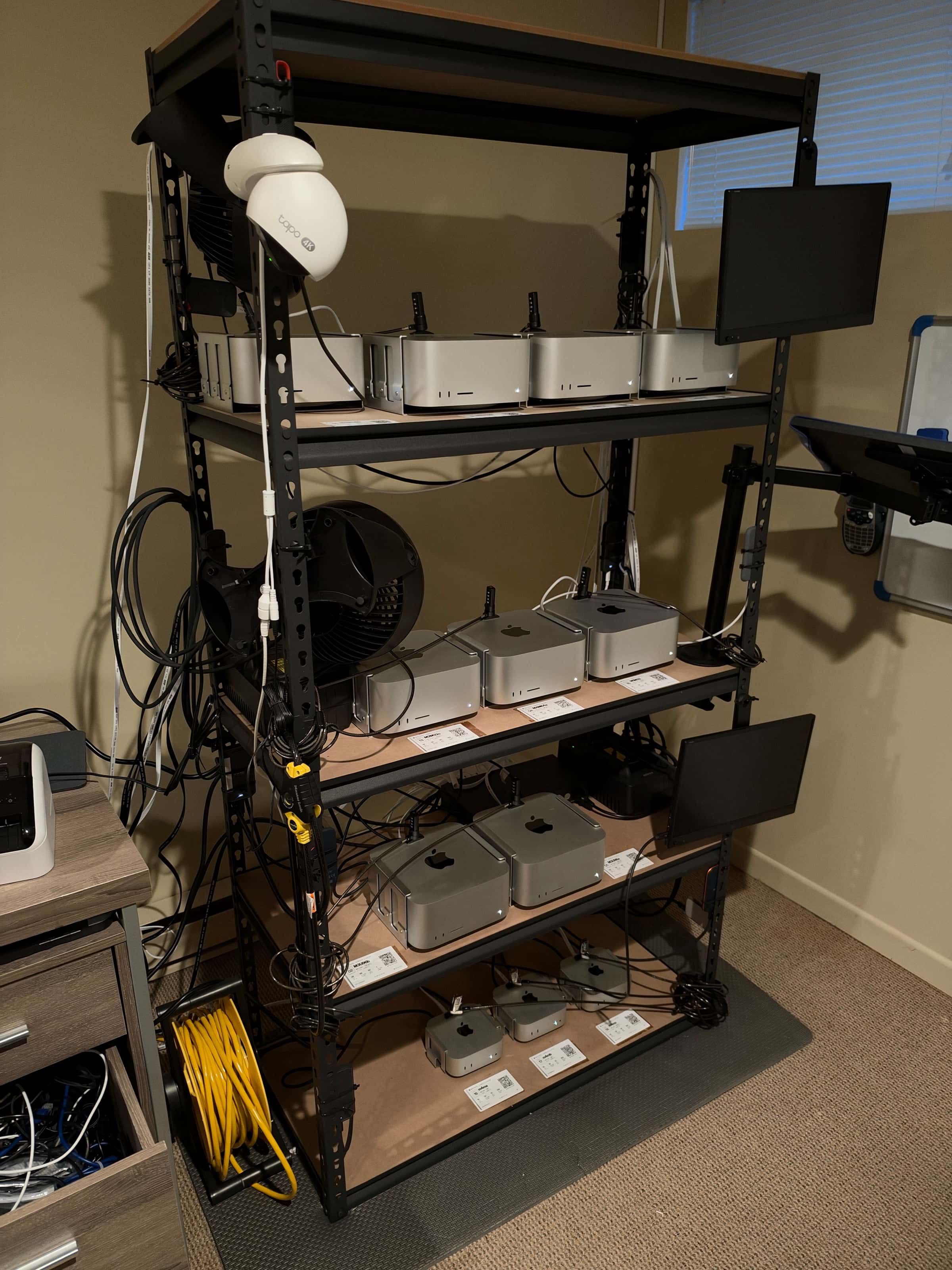
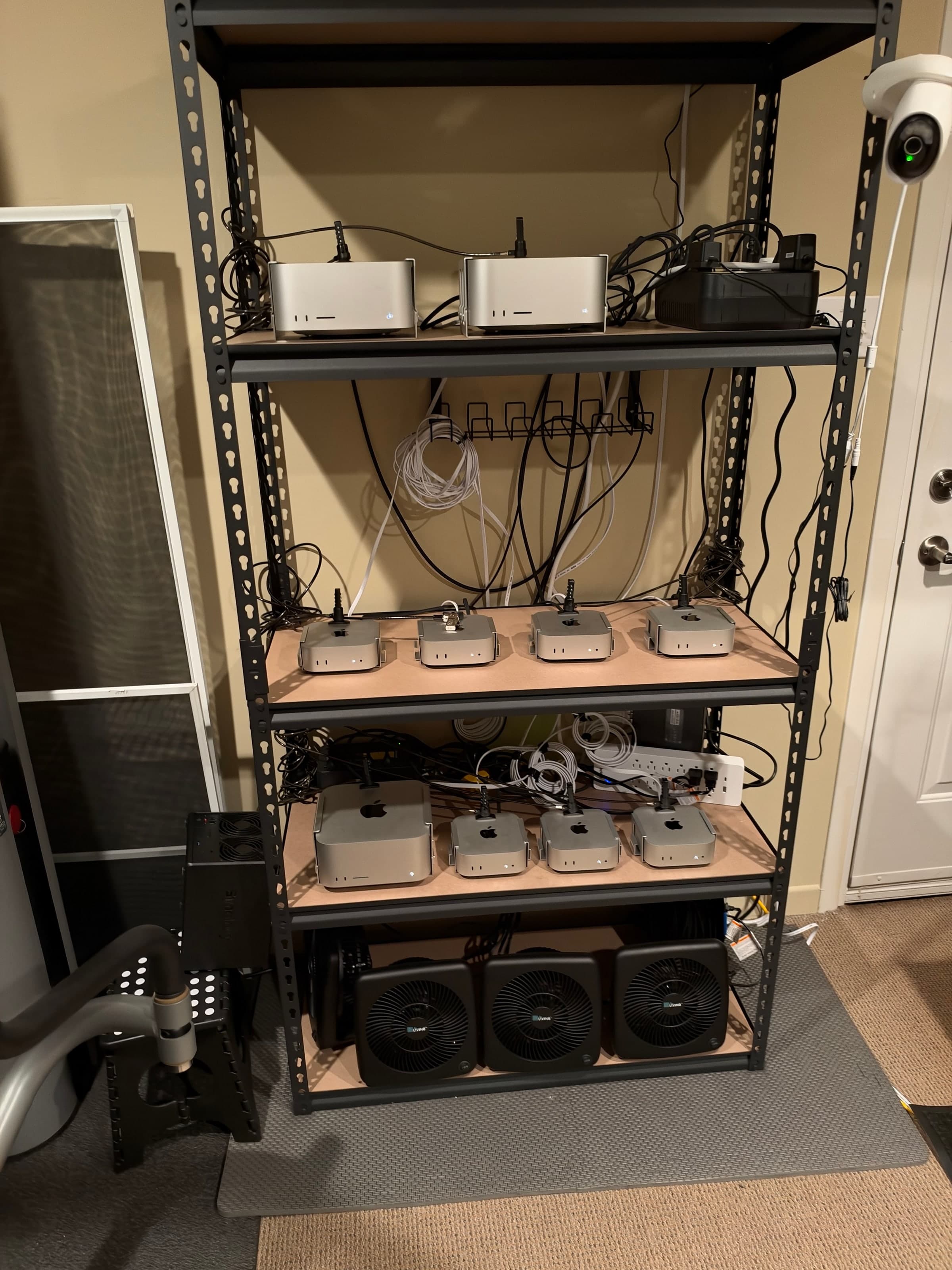
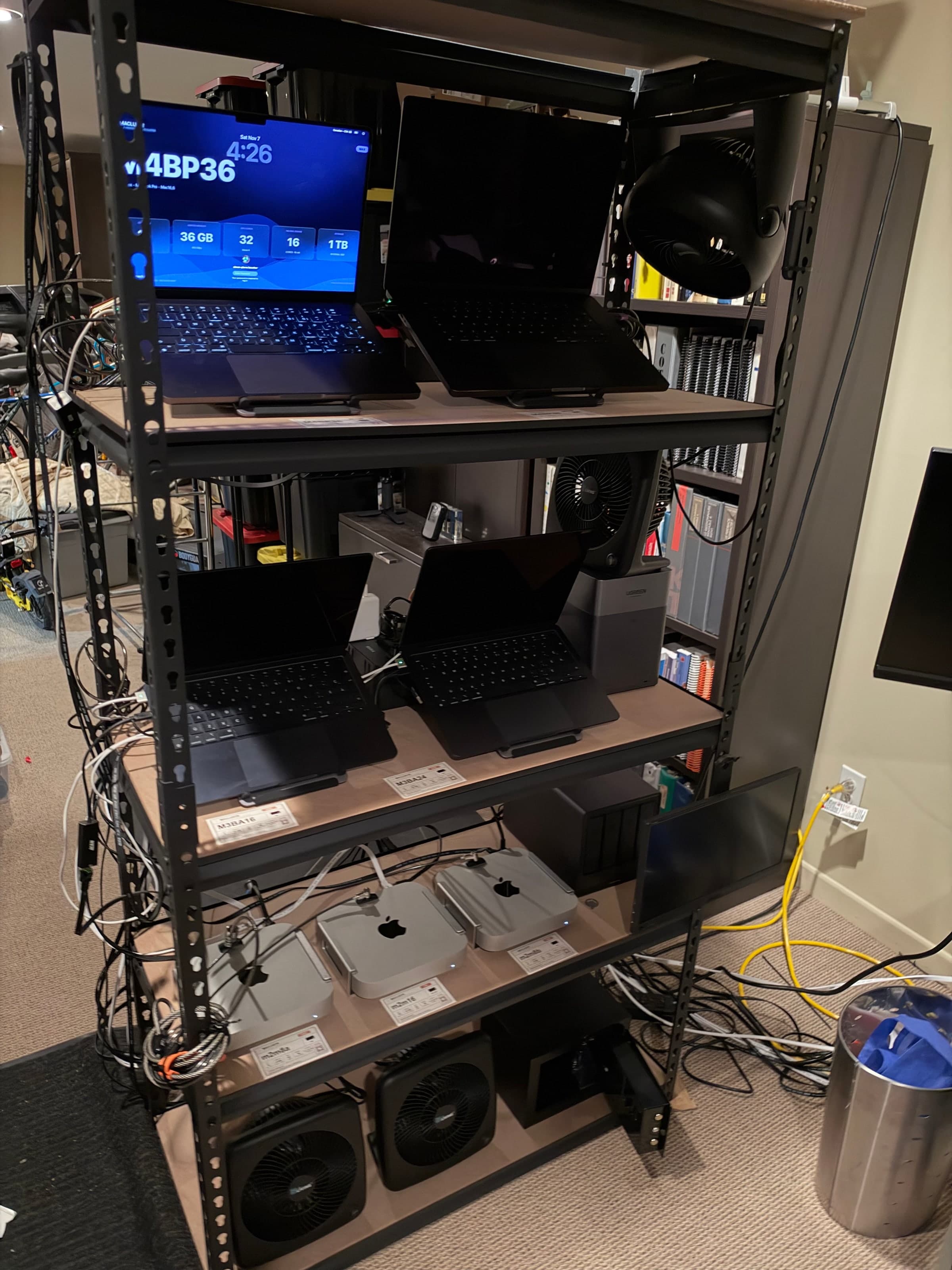
I built MacLustr gradually, starting from a few Mac Studio computers and adding Mac mini and laptop nodes as research needs grew. It lives on ordinary industrial shelving, not in a data centre.
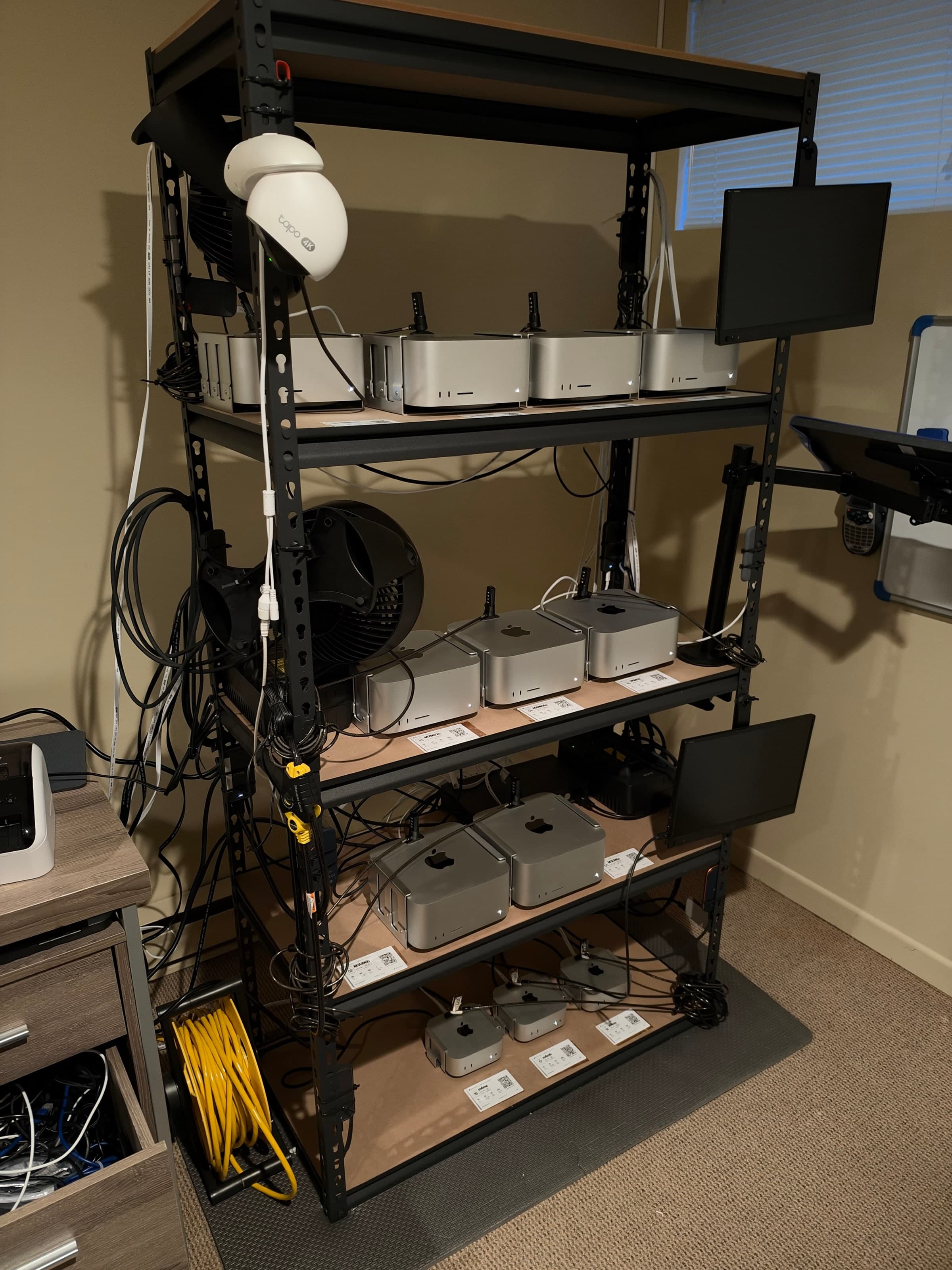
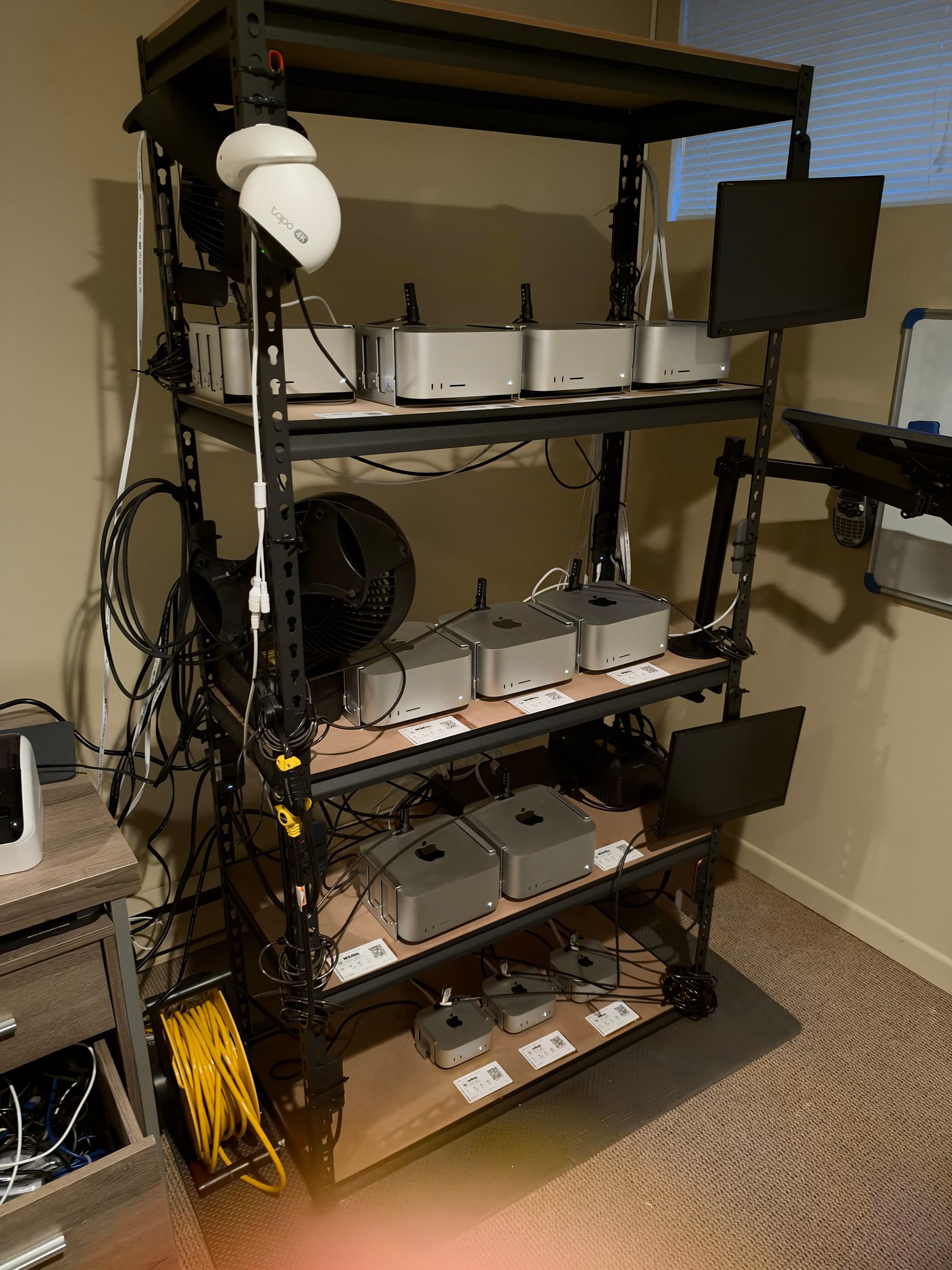
Nothing on this site is rendered or staged. The photographs show the cluster as it runs: labelled machines, tied cable runs, floor fans pushing air up through the shelves, and laptops working with their lids open.
Topology
How the machines are connected
A simplified map. It groups machines by kind and shows roles, not addresses; the internal layout is deliberately left out.
Select a block to read what it does.
- Local wired network
- Encrypted tunnel
04 / 08
Wired Ethernet
Every machine reports a 1 GbE negotiated link. This is the measured rate; no faster interconnect is claimed.
Hardware
Four kinds of machine
Each family leads to its individual node records.
13
Mac mini
13 machines
296 GB unified memory
M4 Pro · M4 · M6 · M5 Pro · M2 Pro · M2
View all12
Mac Studio
12 machines
648 GB unified memory
M3 Ultra · M2 Ultra · M4 Max · M5 Max · M2 Max · M1 Max
View all2
MacBook Air
2 machines
40 GB unified memory
M3
View all2
MacBook Pro
2 machines
84 GB unified memory
M4 Max
View all
Research themes
What the cluster is used for
- 01Active
Local language models
Running and studying open-weight models on machines I control: architecture experiments on small models, and inference on larger ones within a single node's memory.
- 02Active
Apple Silicon and MLX
Measuring what unified memory and the Apple GPU can do for numerical work, with MLX for models and Metal for custom kernels.
- 03Active
Distributed workloads
Statistical methods designed for many machines and few communication rounds, tested on real hosts rather than simulated ones.
- 04Active
Scientific computing
Large batch computations in econometrics and data analysis, split into independent jobs and placed in proportion to each node's cores.
- 05Active
Agentic research
Autonomous coding agents operate the cluster through a single gateway, and are themselves a subject of study.
- 06Planned
Reproducible benchmarking
A fixed protocol for comparing chip generations on identical models and prompts. The protocol is published; the measurements are not yet.
Selected work
Experiments that ran here
Each entry states how the cluster was actually used, including when it was a single machine.
Working Paper 40 ·
RAID: A Metal-Accelerated C++ Framework for Reproducible High-Frequency Financial Econometrics
Use of the cluster — One experiment of the paper runs the same workload across eleven machines of the cluster to compare chip generations.
Working Paper 41 ·
Multi-Resolution Context in Intraday Probabilistic Return Forecasting: A Pre-Registered, Matched-Budget Measurement on 300 U.S. Instruments
Use of the cluster — Training and evaluation ran on a single Mac Studio M3 Ultra node: one machine, not a distributed run.
Working Paper 28 ·
Beyond One-Step Distributed Maximum Likelihood: Local Bias Cancellation, Global Synchronization, and the Price of Inexact Curvature
Use of the cluster — This is the cluster's clearest case of real distributed parallelism: the Monte Carlo study ran on 18 nodes and the real-host testbed used 16 machines exchanging messages over TCP.
Collaboration
Interested in using MacLustr for research?
MacLustr primarily supports my own research. I am open to discussing collaborations and, where capacity and project fit permit, access for external researchers. Requests are reviewed individually; access is not guaranteed.